Fossils and ancient animate being sometimes tend to give researchers aheadachejust as much as they play excitement to the squad . One such item is part of a marine tapeworm that has been discoveredtrapped in gold – quite how a nautical sponge ended up trapped in tree diagram resin is leaving scientists scratching their top dog .
The dodo is remember to be a species of the class Cestoda course of instruction , also know as tapeworms , that date back to 99 million years ago . The cestode is trapped in mid - Cretaceous Kachin amber and was ground in Myanmar . Cestoda is a widespread class that can even infect humans and is feel in pretty much every ecosystem , includingmarine environments .
The ordertrypanorhyncha , to which our ancient pin critter belong , typically taint marine species ofsharks and raysas larvae . Almost all livingtrypanorhynchaare endoparasites of sharks and rays . However , because of their complex life cycles that regard two hosts and piano bodies , they are only roll in the hay in the fossil record from ballock find in shark coprolite .
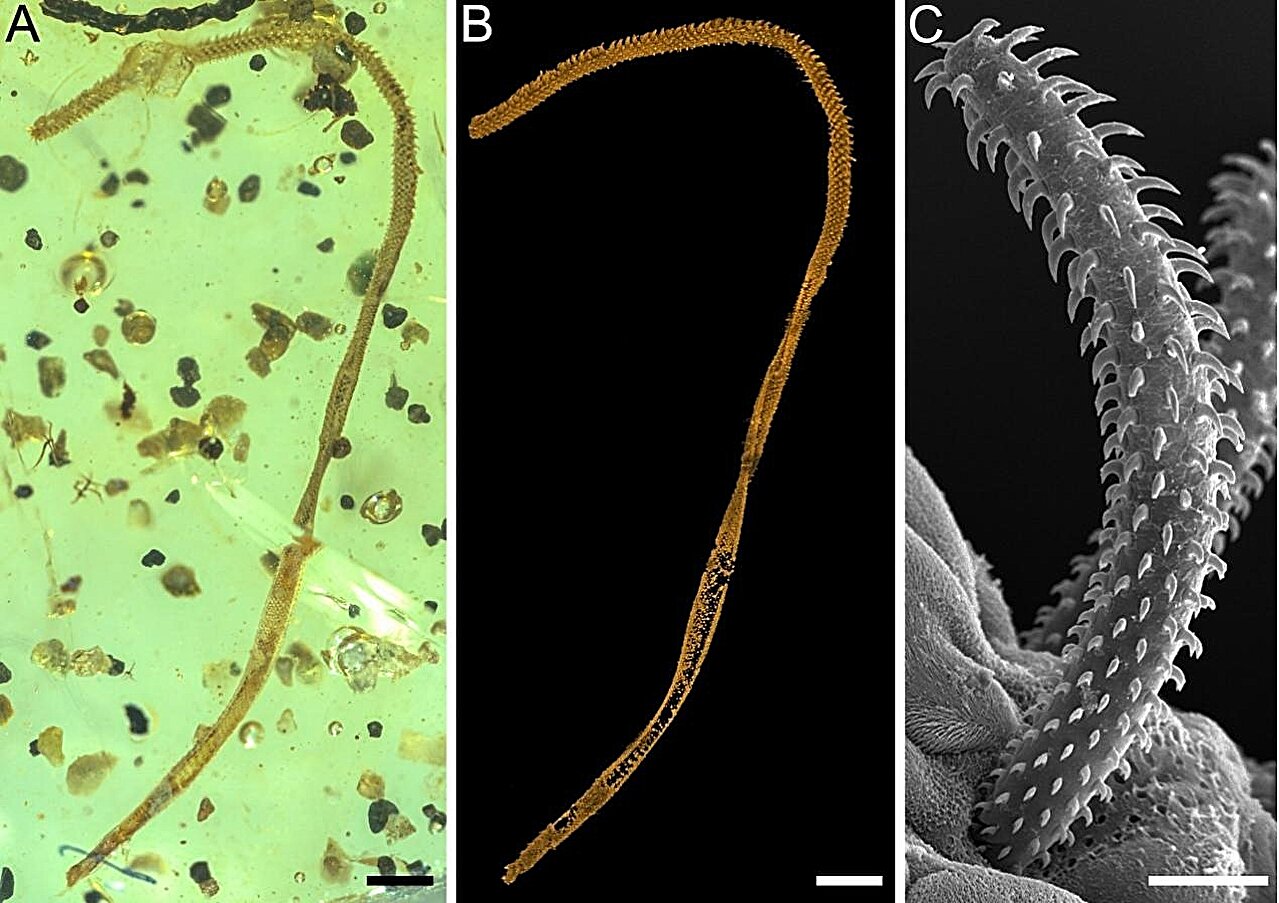
The fossil tapeworm tentacle compared to an extant species of trypanorhynch tapeworm.Credit: NIGPAS
" The fossil disk of tapeworms is extremely thin due to their flabby tissues and endoparasitic habitats , which greatly cramp our understanding of their early evolution , " said Wang Bo , the subject ’s lead researcher in astatement . However , he added that his team had " reported the first organic structure fogey of a tapeworm . "
The gold has led to the special preservation of the dodo , meaning it is likely the most convincing body fossil of flatworm ever find . The fossil , though incomplete , is long and slight and has incredible outside and national feature article along the tentacle , and rootless empty hooks .
" This bring in the current find the most convincing body fossil of a flatworm ever regain , " say Luo Cihang , first author of the study and a PhD candidate from NIGPAS .
As well as the tip endoparasite there are also fern trichomes and an louse nymph also trapped in the amber , further hint that the tapeworm was on land at the time of becoming entomb in the amber itself . The gold also contains sand grains , suggesting that it might have been a shoring surround . The team also write that the end of the fogey is break , evoke it was ripped apart .
The authors indicate that the host for the parasite , the shark or ray , was stranded on a arenaceous shoreline after strong winds or tidal surges . The shark was then predate upon , and the sponge was pulled off from the intestine and stuck into nearby resin . They emphasize that this is a risky idea , but spotlight the grandness of amber in preserving unexpected fossil .
" Our survey further back the theory that the Kachin gold was probably deposited in a paralic paleoenvironment , and also highlight the grandness of amber research in paleoparasitology , " land up Wang .
The paper is bring out in the journalGeology .
